1. What is IQF Wave Sliced Carrot?
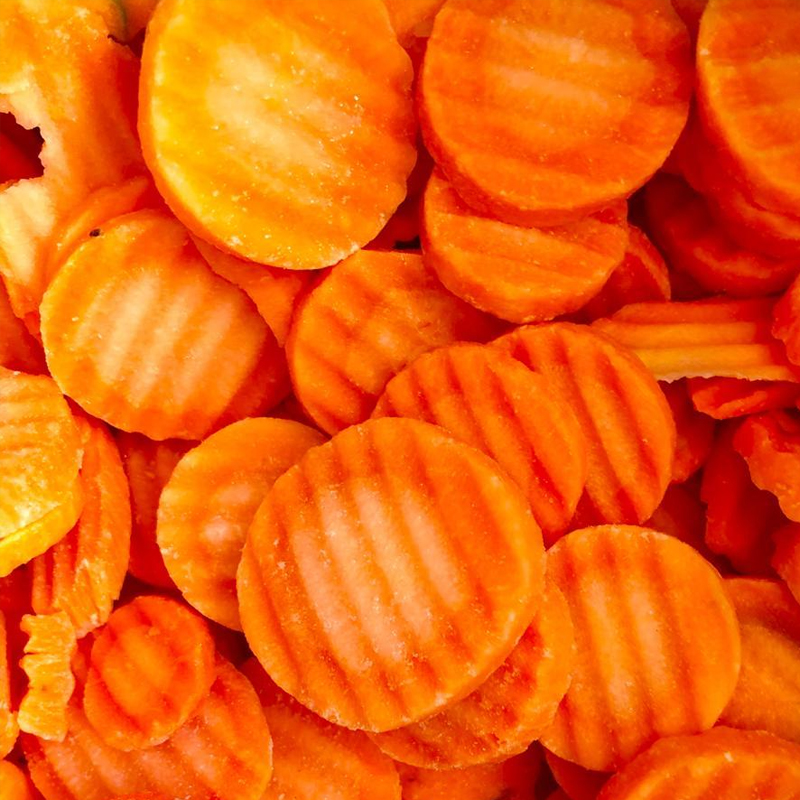
IQF wave sliced carrots are wavy-shaped slices made using Individual Quick Freezing (IQF) technology. These carrots undergo a rigorous processing process: fresh carrots are carefully selected, washed, peeled, and sliced using special wave-shaped blades. They are then rapidly frozen in an IQF freezing tunnel at extremely low temperatures of -30°C to -40°C. During this process, each slice is individually and rapidly frozen, preventing ice crystals from clinging to each other, resulting in a frozen product with distinct, distinct grains.
The core advantage of IQF technology lies in its freezing method. Unlike traditional freezing methods, IQF significantly reduces the size of ice crystals formed during the freezing process. Scientific research has shown that when freezing rates exceed 5°C per minute, the diameter of ice crystals formed within cells can be controlled to less than 100 microns. These tiny ice crystals do not pierce the plant cell walls, thereby maximizing the integrity of the cellular structure of the raw material. For example, Yuyao Gumancang Food Co., Ltd. uses an IQF fully automated production line that precisely controls the temperature profile during the freezing process, ensuring that the product maintains a rapid cooling state throughout its core temperature of -18°C.
From a microbiological perspective, IQF processing also effectively inhibits microbial activity. When the product temperature rapidly passes through the maximum ice crystal formation zone of -1°C to -5°C, the water within the microbial cells freezes simultaneously, preventing any adaptive reactions that may occur during the slower freezing process. This rapid freezing method ensures that the product maintains high quality while also ensuring food safety.
2. What is the shelf life of IQF Wave Sliced Carrots?
The shelf life of IQF Wave Sliced Carrots depends primarily on three key factors: the initial quality of the raw materials, the level of processing technology, and standardized storage conditions. With a complete cold chain system, these products typically maintain peak quality for 18-24 months.
From a food chemistry perspective, shelf life is determined based on the rate of change of multiple quality indicators. Carotenoid retention (primarily beta-carotene) is a key performance indicator. Research shows that at a constant temperature of -18°C, IQF-treated carrots experience a monthly carotenoid loss of less than 0.5%, while at -12°C, the monthly loss can reach over 2%. Texture change is also a key consideration. Under proper storage conditions, IQF products can retain over 85% of their initial firmness over 12 months.
Oil oxidation is another key factor affecting the shelf life of frozen vegetables. Although carrots have a low fat content (approximately 0.2%), oxidation of unsaturated fatty acids can still lead to flavor degradation. At -18°C, the peroxide value growth rate can be controlled to less than 0.02 meq/kg per month. Yuyao Gumancang Food Co., Ltd. utilizes a refrigerated storage system with a daily storage capacity of 10,000 tons, ensuring a stable low-temperature environment throughout the entire storage period.
It is important to note that shelf life is premised on maintaining a continuous and stable low-temperature chain. Temperature fluctuations exceeding ±3°C can cause recrystallization, where small ice crystals melt and reform into larger ones, accelerating product quality deterioration. Therefore, temperature monitoring is crucial throughout the entire distribution process, from production to consumer.
3. What are the application scenarios of IQF Wave Sliced Carrots in the catering industry?
IQF wave-sliced carrots have broad application value in the catering industry, with their primary advantages being ease of use, consistent quality, and cost control.
In the corporate catering sector, IQF wave-sliced carrots can meet the needs of large-scale catering preparation. By eliminating pre-processing steps such as washing, peeling, and slicing, they can save over 40% in kitchen labor costs. The unique shape of the wave-sliced carrots increases surface area, ensuring more even heating during cooking and reducing cooking time by approximately 25%. This product can significantly improve serving efficiency, especially in settings like schools and corporate cafeterias where large quantities of food are prepared.
In the fast food industry, product consistency is particularly important. IQF wave-sliced carrots are highly standardized, with thickness tolerances within ±0.5mm per slice. This consistency ensures a standardized cooking process. For example, in side dish applications, the fixed slice thickness means predictable cooking times, facilitating the establishment of standard operating procedures (SOPs). The wavy shape also enhances the product's visual appeal, making it more aesthetically pleasing in salads, side dishes, and other applications.
High-end dining establishments value its consistent quality. Because IQF technology maximizes the preservation of fresh carrots' color, texture, and flavor, Michelin-starred restaurants also use it in creative dishes that require the integrity of the shape. The three-dimensional shape of the wavy slices allows for better adhesion to sauces, enhancing the overall flavor of the dish.
Furthermore, when used as an ingredient in food processing plants, the traceability and consistent quality of IQF wave-sliced carrots make them an ideal choice for pre-prepared dishes, frozen meal kits, and other products. With an annual processing capacity of 8,000 tons of vegetables, the production scale ensures a stable supply of raw materials for large food manufacturers.
4. What is the difference between IQF Wave Sliced Carrots and traditionally sliced carrots? IQF wavy-sliced carrots differ significantly from traditional sliced carrots in several areas, primarily in processing, quality characteristics, and user experience.
From a processing perspective, traditional sliced carrots are typically blanched in hot water followed by slow freezing. This process can result in up to 30-40% cell damage and significant juice loss after thawing (up to 15-20%). IQF technology, by rapidly freezing, reduces cell damage to less than 5% and reduces thawing juice loss to less than 3%. Regarding microbiological indicators, IQF products must meet international frozen vegetable standards, typically maintaining a total aerobic colony count below 10⁴ CFU/g, a standard that traditional frozen products often struggle to meet.
There are significant differences in nutrient retention. Research has shown that IQF-treated carrots retain over 85% of vitamin C, while traditional freezing methods only retain 60-70%. The difference in β-carotene retention is even more pronounced, with IQF products retaining over 90% of the carotenoids, while traditional products experience a 30-40% loss. This is primarily due to the fact that rapid freezing reduces the time it takes for oxidation reactions.
In terms of ease of use, IQF products are ready to use, requiring no pre-processing. They also disperse well and avoid clumping. Traditional frozen carrots often freeze in lumps, requiring tapping or partial thawing before they can be separated and used. This is not only inconvenient but also accelerates quality deterioration due to repeated thawing and freezing.
Sensory quality comparisons show that IQF wave-sliced carrots maintain a good crispness after thawing (hardness values measured by a texture analyzer are within the range of 2000-2500 g force) and a bright color (L value > 50 and a value > 30 measured by a colorimeter). Traditional frozen products, on the other hand, have a soft texture (hardness values < 1500 g force) and a dull color (a* value < 25).
5. What are the unique advantages of the wave-sliced carrots of IQF?
The wave-sliced design of IQF carrots is not simply a cosmetic innovation; it is a professional design that integrates multiple considerations, including food engineering, thermodynamics, and consumer psychology.
From a processing perspective, the wavy shape increases the surface area of the sliced product by approximately 30-40%, significantly improving freezing efficiency. Physics research shows that increasing the surface-to-volume ratio can increase heat exchange efficiency by over 25%. This means that wavy slices can pass through the zone of maximum ice crystal formation more quickly, further reducing ice crystal size. The wavy shape also prevents full contact between slices, reducing sticking during freezing, which helps maintain the distinct grain characteristics of IQF products.
In terms of cooking performance, the unique geometry of the wavy slices creates an uneven heat transfer environment. When heated, thinner areas cook first, followed by thicker areas. This gradient cooking phenomenon allows the product to maintain distinct textures across different sections. The wavy shape also provides greater structural stability, preventing the product from falling apart during long cooking processes like stewing, maintaining its shape integrity.
From a sensory perspective, wavy slices enhance the product's visual appeal. Psychological research shows that irregular shapes can increase visual dwell time by over 20%, enhancing consumer anticipation. In terms of taste, the wavy slices create a rich and varied texture experience, with varying thicknesses creating a blend of crisp and tender textures. From a nutritional perspective, it also offers unique advantages. The increased surface area of carrots allows for greater contact with digestive enzymes, theoretically improving the bioavailability of beta-carotene. Studies have shown that after cooking, the in vitro bioavailability of carotenoids in wavy-sliced carrots is 15-20% higher than in conventionally sliced carrots.
Furthermore, in foodservice applications, the wavy-sliced design better retains sauces and seasonings, enhancing the overall flavor of the dish. This design also reduces breakage during cooking, improving yields and offering significant economic benefits in commercial applications.



 English
 中文简体
中文简体 日本語
日本語