1. What is IQF Broccoli?
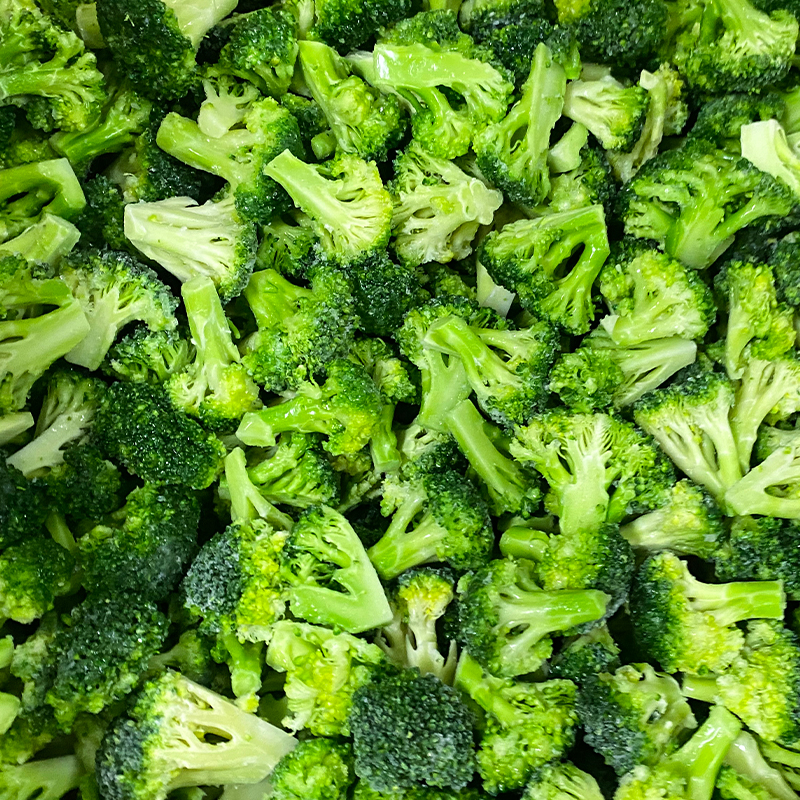
IQF broccoli, or Individual Quick Freezing (IQF), is a vegetable product processed using advanced freezing technology. This technology rapidly freezes broccoli florets at extremely low temperatures (typically -30°C to -40°C) using high-velocity airflow. This ensures that each floret is individually frozen, preventing clumping and preserving its natural color, texture, and nutritional value. IQF technology uses ultra-low temperatures to rapidly pass through the ice crystal formation zone, effectively preventing the formation of large ice crystals that could damage the plant's cell structure. This ensures that the product retains its excellent taste and nutritional value after thawing.
For example, Yuyao Gumancang Food Co., Ltd. has installed three fully automated IQF production lines (one for aquatic products and two for vegetables) that utilize this principle. Its annual processing capacity reaches 8,000 tons of vegetables and 6,000 tons of aquatic products, and its low-temperature cold storage facility boasts a daily storage capacity of 10,000 tons, ensuring the effective implementation of IQF technology and consistent product quality. Its production process strictly adheres to relevant food safety and quality management standards.
2. How to Determine the Quality of IQF Broccoli?
Judging the quality of IQF broccoli requires a systematic assessment of multiple objective indicators. These indicators directly reflect the quality of the raw materials, processing techniques, and storage and transportation capabilities:
Color: High-quality IQF broccoli should be a uniform, bright or dark green, reflecting the use of high-quality raw materials and timely processing. A yellowish color indicates prolonged storage or improper blanching during processing; a grayish-brown color may indicate oxidative browning during processing or storage.
Appearance and Integrity: The florets should be intact, with clean cut surfaces and no excessive debris, stems, or leaves. This reflects the meticulousness of the pre-processing process. The product should be uniform in size and conform to the specifications marked on the packaging.
Glaze: The product should have a thin, even, transparent glaze on its surface. This glaze protects the product from dehydration (freezer burn) caused by temperature fluctuations during storage. Excessively thick glaze may affect the product's net weight and taste, while uneven, clumping, or excessive frost on the surface may indicate that the product has experienced temperature fluctuations during storage or transportation.
Impurities: The product should be free of any foreign matter, such as metal fragments, sand, or hair. It should also be free of non-broccoli components, such as excessive stem skin or off-color plant parts. This reflects the cleanliness and quality control of the production line.
Odor and Taste: After thawing, the product should have the characteristic fresh broccoli aroma, free of any foreign, rancid, or refrigerated odors. After cooking, it should have the normal broccoli flavor without any unpleasant aftertaste.
Packaging and Labeling: The packaging bag should be intact, free of holes or air leaks. Label information must be clear and complete, including product name, specifications, production date, batch number, expiration date, and manufacturer information (e.g., Yuyao Gumancang Food Co., Ltd.), and must comply with relevant food labeling regulations.
3. Do IQF broccoli need to be thawed before use?
In principle, IQF broccoli are designed to be used directly without prior thawing, which is one of their greatest advantages. Whether or not to thaw depends on the specific application and cooking purpose:
No thawing required (direct use): For most cooking scenarios, such as stir-frying, steaming, making soups, and preparing side dishes in the oven or air fryer, cooking directly from frozen is recommended. Direct high-temperature heating accelerates the ice crystal melt phase, minimizing juice loss and thus better preserving texture, color, and nutrients.
When thawing is necessary: Thawing is only necessary in certain specific situations. For example, when broccoli needs to be mixed evenly with other non-frozen ingredients (e.g., in salads or as a topping), or when precise portioning is required. For thawing, refrigerated thawing (moving the product to a refrigerated environment at 0-4°C for slow thawing) is recommended to prevent microbial growth and quality degradation caused by thawing at room temperature. After thawing, drain any excess water and use as soon as possible to avoid repeated freeze-thaw cycles.
4. What are the main applications of IQF broccoli?
Due to its standardization, convenience, long shelf life, and year-round supply, IQF broccoli has become a key ingredient in the modern food industry, with a wide range of applications:
Catering and Group Catering: It is a core ingredient in restaurants, hotels, schools, hospitals, corporate cafeterias, and central kitchens. Its pre-cleaned and pre-cut nature significantly reduces pre-processing time, labor, and food waste in the kitchen, improving food delivery efficiency and standardization. It is commonly used in Chinese stir-fries, Western side dishes, salads, and soups.
Food Processing: As a pre-processed ingredient, it is widely used in a variety of further processed foods. For example, IQF broccoli can be used as a key component of mixed frozen vegetable packs, as an ingredient in prepared dishes (such as curry and meal kits), as a pizza topping, as an ingredient in baby food purees, and added to soup and instant porridge.
Retail Market: Sold as single frozen vegetables or mixed vegetable packs in supermarkets and other retail channels, it meets the daily cooking needs of home consumers and provides a convenient, waste-reducing vegetable option.
Special Channels and International Supply Chains: Its stable shelf life makes it ideal for supplying shipping catering, military supplies, and other sectors that require extremely stable supply chains. Furthermore, thanks to the processing capabilities of customs-registered companies like Yuyao Gumancang Food Co., Ltd., IQF broccoli meets international standards, enabling it to participate in the global food supply chain and be exported to overseas markets.
5. IQF Broccoli Processing Process
5.1 Raw Material Screening and Pretreatment
IQF broccoli processing begins with raw material screening. Fresh broccoli with compact, bright green buds and free of pests and diseases should be selected. Processing must begin within 8 hours of harvesting to maximize nutrient retention. Pre-processing includes washing, destemming, cutting into uniform florets (typically 2-3 cm in diameter), and passing through a bubble washer to remove impurities.
5.2 Blanching
Blanching is a critical step in IQF processing. It inhibits enzyme activity (such as peroxidase and polyphenol oxidase) through a brief, high-temperature (typically 95-100°C) steam or hot water treatment, preventing color degradation and flavor loss during frozen storage. The blanching time must be precisely controlled (typically 60-90 seconds). Excessive blanching results in a softened texture, while insufficient blanching fails to fully inactivate enzymes.
5.3 IQF Freezing Process
After blanching, the broccoli is immediately cooled to room temperature and centrifuged to remove surface moisture. The broccoli is then placed in an IQF freezer. The fully automated production line used by Yuyao Gumancang Food Co., Ltd. typically uses spiral freezers set at -35°C to -40°C, with a freezing time of approximately 5-7 minutes. High-speed airflow suspends the broccoli particles, allowing them to be individually frozen.
5.4 Packaging and Storage
After freezing, the broccoli undergoes metal detection and screening to remove unqualified products. It is then vacuum-packed or nitrogen-filled according to specifications (e.g., 500g x 20 bags/box) to prevent oxidation and freezer burn. Finished products are stored in cold storage at temperatures below -18°C. Yuyao Gumancang Food Co., Ltd. has a daily storage capacity of 10,000 tons, ensuring product stability.
6. Which is more nutritious, IQF broccoli or fresh broccoli?
From a food science perspective, there are subtle differences in nutritional content between IQF broccoli and freshly picked "field-fresh" broccoli. However, IQF broccoli may retain more nutrients than "market-fresh" broccoli after extended transportation, storage, and shelf life.
The Impact of Processing and Freezing on Nutrition: IQF processing typically includes blanching, a brief heat treatment to inactivate enzymes and kill bacteria. This step results in the loss of some water-soluble vitamins (such as vitamin C and some B vitamins). However, the subsequent rapid freezing effectively "locks in" most of the remaining nutrients, including vitamins, minerals, and antioxidants (such as carotenoids and phenolic compounds).
Comparison with "market-fresh" vegetables: From harvest to consumer, fresh broccoli typically undergoes several days or even weeks of transportation, storage, and shelf life. During this period, nutrients (especially labile nutrients like vitamin C) continuously degrade due to respiration, enzymatic reactions, and light exposure. Studies have shown that the nutritional value of fresh vegetables can significantly decrease after long-distance transportation and storage.
Therefore, the nutritional value of IQF broccoli is closer to that of immediately frozen broccoli after harvest. While blanching may lose some heat-sensitive nutrients, it successfully prevents subsequent nutrient degradation. While "market-fresh" broccoli may be more palatable, its nutritional value depends on the time and conditions between harvest and consumption. Overall, both are good sources of dietary nutrition, and IQF technology provides a convenient solution that effectively preserves nutrients, especially when the product is out of season or when the supply chain is long.



 English
 中文简体
中文简体 日本語
日本語