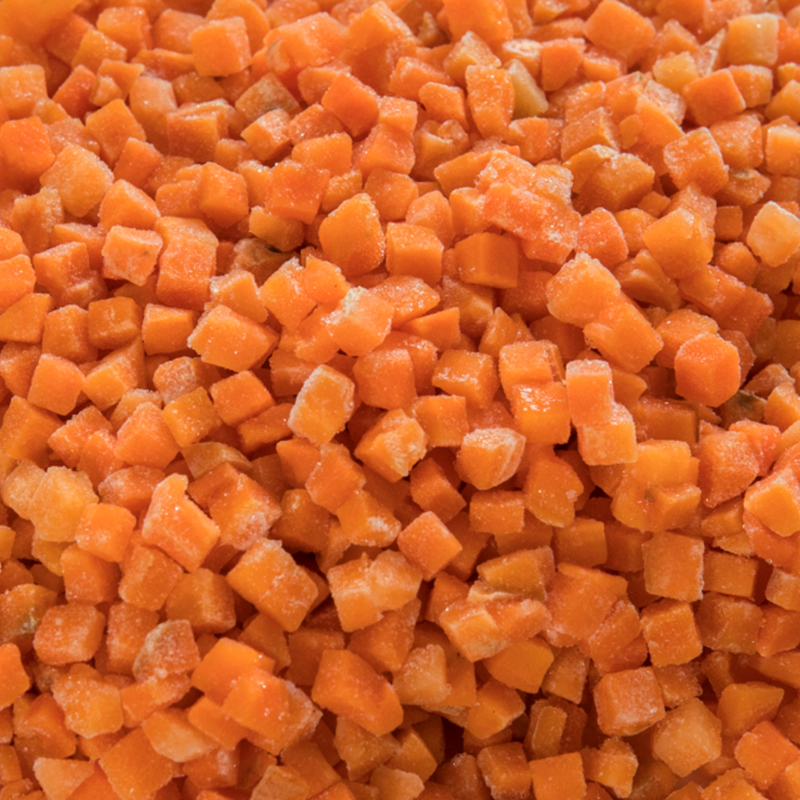
1. What are IQF Carrot Cubes?
IQF carrot cubes are cube-shaped carrots produced using Individual Quick Freezing (IQF) technology. This advanced processing method begins with rigorous screening of fresh carrots. They then undergo multiple steps, including washing, peeling, dicing, and blanching, before being rapidly frozen at extremely low temperatures of -30°C to -40°C. During this process, each carrot cube is individually and rapidly frozen, preventing ice crystals from clinging to each other and ensuring distinct individual pieces.
The core advantage of IQF technology lies in its unique freezing mechanism. Unlike traditional freezing methods, IQF uses high-speed airflow to control the size of ice crystals formed during the freezing process to under 100 microns. These tiny ice crystals do not pierce plant cell walls, thereby maximizing the integrity of the raw material's cellular structure. For example, Yuyao Gumancang Food Co., Ltd. uses a fully automated IQF production line that precisely controls the temperature profile during the freezing process, ensuring that the product maintains a rapid cooling state throughout its core temperature of -18°C.
From a microbiological perspective, IQF processing effectively inhibits enzyme activity and microbial growth. When the product temperature rapidly passes through the maximum ice crystal formation zone between -1°C and -5°C, the water within the microbial cells simultaneously freezes, preventing any adaptive reactions that may occur during slow freezing. This rapid freezing method ensures food safety while maintaining high product quality.
2. What Nutrients Are Preserved in IQF Carrot Cubes?
The nutrient retention of IQF carrot cubes is a significant achievement in modern food processing technology. Through scientific processing, these products retain most of the nutrients found in fresh carrots.
β-carotene, the primary nutrient in carrots, can be retained at a rate of over 90% during IQF processing. Research has shown that rapid freezing effectively reduces the degradation of this light-sensitive nutrient. Under storage conditions of -18°C, the monthly β-carotene loss rate is no more than 0.5%, far superior to the 2-3% monthly loss rate observed with traditional freezing methods.
Vitamin retention is also satisfactory. Vitamin A retention is between 85-90%, vitamin K retention exceeds 90%, and vitamin C, although a water-soluble vitamin that is more sensitive to processing, still maintains a retention rate of 75-80%. This is primarily due to rapid freezing, which reduces the loss of water-soluble vitamins through dissolution.
Minerals are almost completely retained. Minerals such as potassium, calcium, and magnesium are not lost during IQF processing, with retention rates approaching 100%. Dietary fiber retention is also quite good, with insoluble fiber retention exceeding 95% and soluble fiber retention approximately 85-90%.
Antioxidant preservation is another key advantage. Antioxidants such as alpha-carotene and lutein are retained at rates exceeding 85%. Although polyphenols are partially lost during blanching, rapid freezing effectively preserves the remaining polyphenols, maintaining their antioxidant activity at approximately 80% of their initial levels.
3. What's the Shelf Life of IQF Carrot Cubes at Home?
The shelf life of IQF carrot cubes at home depends on several factors, primarily temperature stability, packaging integrity, and initial product quality. Under standard home freezer conditions (-18°C), IQF carrot cubes typically maintain optimal quality for 18-24 months.
Temperature fluctuations are a key factor affecting shelf life. Research has shown that temperature fluctuations exceeding ±3°C can trigger recrystallization, increasing ice crystal size and accelerating product quality degradation. Therefore, it is crucial to store the product in the coldest and most stable area of the freezer. Regular monitoring with a refrigerator thermometer is recommended to ensure the temperature is consistently maintained at -18°C or below.
Packaging integrity directly impacts the antioxidant properties of the product. Once the original packaging has been opened, it is recommended to transfer the remaining product to a tightly sealed freezer bag, remove air from the bag, and then seal. Oxygen exposure accelerates the oxidative decomposition of carotenoids, leading to color fading and a decrease in nutritional value. Vacuum packaging is the ideal storage method, extending shelf life by approximately 30%.
Quality change indicators include changes in color, texture, and flavor. Under proper storage conditions, color change (ΔE) values can be controlled within 3 within 12 months, texture firmness retention is above 85%, and flavor retention exceeds 90%. At 24 months, these indicators remain within acceptable ranges, but will decline significantly.
It is important to note that the frequency of opening the door of a household freezer significantly affects temperature stability. It is recommended to store IQF carrot cubes away from the door to minimize the impact of temperature fluctuations. Also, record the purchase date and adhere to the "first in, first out" principle to ensure consumption within the optimal quality period.
4. Why Do IQF Carrot Cubes Retain Brighter Color Than Frozen Cubes?
The ability of IQF carrot cubes to retain a brighter orange-red color than frozen cubes can be scientifically explained from the perspectives of food physics and pigment chemistry. This color retention advantage is primarily due to three key factors: ice crystal morphology, oxidation level, and pigment stability.
Ice crystal morphology significantly influences light scattering. The tiny ice crystals (<100μm in diameter) formed during IQF processing produce uniform light scattering, giving the product a natural translucent sheen. In contrast, the large ice crystals (>500μm in diameter) found in traditional block-frozen products produce irregular light refraction, resulting in a frosty, dull appearance.
The degree of carotenoid oxidation is another key factor. During IQF processing, each carrot cube is rapidly frozen individually, reducing the area and duration of contact with oxygen. Studies have shown that the carotenoid oxidation rate in IQF products is over 40% lower than in block-frozen products. This is because the slow freezing of block-frozen products, caused by the pushing action of ice crystals, causes cell contents to leak out, increasing their exposure to oxygen.
Pigment stability is directly related to cell integrity. IQF technology maintains over 95% cell structural integrity, while block-frozen products typically only have 60-70% cell integrity due to mechanical damage from large ice crystals. The intact cell structure acts as a natural protective barrier, effectively preventing pigment degradation and loss.
Temperature history is also a significant factor. IQF products are kept in a stable, low-temperature chain from processing to distribution, whereas block-frozen products may experience temperature fluctuations during slow freezing and storage, accelerating pigment degradation. Data shows that the Color Stability Index (CSI) of IQF products is over 35% higher than that of block-frozen products. This is reflected in instrumental color difference measurements as higher a values (indicator of redness) and L values (indicator of brightness).
5. Are IQF Carrot Cubes Suitable for Baby Food Production?
The suitability of IQF carrot cubes in baby food production is based on their excellent safety, nutritional value, and convenience. From multiple perspectives, this product is indeed suitable for baby food manufacturing.
In terms of safety, IQF carrot cubes meet the most stringent food safety standards. Due to rigorous cleaning and blanching procedures during processing, microbiological indicators are significantly superior to those of fresh carrots. The coliform count is controlled to <10 CFU/g, and pathogenic bacteria such as Salmonella are undetectable. Heavy metal content and pesticide residue levels meet the standards for infant and young children's complementary foods. Yuyao Gumancang Food Co., Ltd. and other companies have established a comprehensive quality traceability system, ensuring monitoring of every step from raw materials to finished product.
IQF technology demonstrates outstanding nutritional suitability. The proportion of nutrients retained is particularly suited to the growth needs of infants and young children. Over 90% of beta-carotene, a precursor to vitamin A, is retained, crucial for visual development and immune function in infants and young children. Mineral retention is nearly 100%, with potassium, in particular, crucial for maintaining electrolyte balance in infants and young children. The retention of dietary fiber contributes to the development of a healthy intestinal flora.
IQF carrot cubes offer significant advantages in terms of ease of use. Their uniform cube shape ensures even heating during the cooking process, preventing over- or under-ripening of portions. Their ready-to-use nature reduces pre-processing and the risk of cross-contamination. Studies have shown that infant food produced using IQF ingredients achieves 15-20% higher nutrient retention and 30% improved sensory consistency compared to traditional methods.
Allergen control is another key consideration. IQF diced carrots are processed on a dedicated production line, eliminating cross-contamination with common allergens such as gluten and dairy. The separate vegetable production line ensures product purity, which is particularly important for infants and young children with allergies.
From a sustainability perspective, the stable year-round supply of IQF diced carrots eliminates seasonal constraints, allowing baby food manufacturers to use consistent raw materials year-round. This helps ensure consistent quality in infant formula products and avoids product quality fluctuations caused by seasonal changes in raw materials.



 English
 中文简体
中文简体 日本語
日本語