1. What is IQF Shiitake?
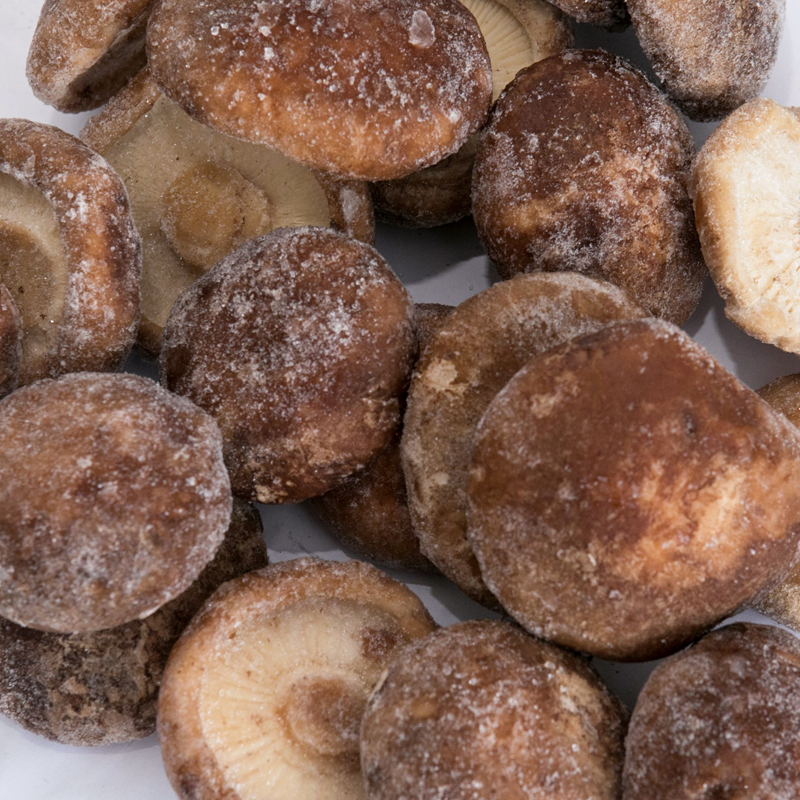
IQF Shiitake is a shiitake product processed using Individual Quick Freezing (IQF) technology. This advanced processing method first rigorously screens fresh shiitake mushrooms to select high-quality raw materials with intact caps and thick flesh. They then undergo multiple processing steps, including cleaning, cutting, and blanching, before being rapidly frozen at extremely low temperatures of -30°C to -40°C. During this process, each shiitake mushroom is rapidly frozen individually, preventing ice crystals from clinging to each other and ensuring distinct product particles.
The core advantage of IQF technology lies in its unique freezing mechanism. Unlike traditional freezing methods, IQF uses high-speed airflow to control the ice crystals formed during the freezing process to a size of 50-100 microns. These tiny ice crystals do not pierce the cell walls of the shiitake mushrooms, thereby maximizing the integrity of the cellular structure. Taking Yuyao Gumancang Food Co., Ltd.'s production practice as an example, its fully automated IQF production line utilizes fluidized freezing technology to ensure rapid cooling of the product throughout its core temperature, reaching -18°C.
From a food microbiology perspective, IQF processing effectively controls enzyme activity and microbial growth. When the product temperature rapidly passes through the maximum ice crystal formation zone of -1°C to -5°C, the water within the microbial cells simultaneously freezes, preventing any adaptive reactions that may occur during the slow freezing process. Data shows that the total colony count of shiitake mushrooms after IQF processing is two orders of magnitude lower than that of traditional freezing, significantly improving product safety. Furthermore, this rapid freezing method effectively inhibits the activity of polyphenol oxidase (PPO) and peroxidase (POD), preventing enzymatic browning.
2. What are the differences between IQF Shiitake and traditionally dried shiitake mushrooms?
IQF and traditionally dried shiitake mushrooms differ significantly in processing technology, nutritional content, and edible quality. In terms of processing technology, dried shiitake mushrooms are dried using hot air or sun drying, reducing their moisture content to 10-13%. In contrast, IQF shiitake mushrooms are rapidly frozen, retaining moisture in the form of ice crystals within their cells, maintaining a moisture content of 70-75%.
There are significant differences in nutrient retention. Research has shown that IQF shiitake mushrooms retain over 85% of vitamin B1 and over 90% of vitamin B2, while conventionally dried products only retain 60-70%. Retention of ergosterol (a vitamin D precursor) is particularly impressive, with IQF products retaining over 95% of ergosterol, which is converted to vitamin D2 after UV irradiation. Ergosterol loss during the drying process can be as high as 30-40%.
Flavor retention is another key difference. IQF technology preserves over 80% of volatile flavor compounds in shiitake mushrooms, including aroma compounds such as 1-octen-3-ol, a characteristic of shiitake mushrooms. In contrast, the heat effects of the drying process can lead to a 30-50% loss of flavor compounds. The texture after rehydration also differs. IQF shiitake mushrooms retain a springiness close to that of fresh ones (with a firmness retention rate exceeding 85%), while dried shiitake mushrooms have a softer texture after rehydration, with a springiness retention rate of only 60-70%.
In terms of ease of use, IQF shiitake mushrooms do not require prolonged soaking and can be cooked directly, saving 2-3 hours of pre-processing time. Dried shiitake mushrooms require soaking in cold water for at least 4 hours, or rapid soaking in warm water for at least 1 hour, and the degree of soaking is difficult to control. In terms of microbiological safety, IQF products undergo blanching to keep the total colony count below 10⁴ CFU/g, while dried products may exceed the microbial limit due to incomplete drying.
3. How do IQF shiitake mushrooms avoid freezer odor?
The technical measures used to prevent freezer odor in IQF shiitake mushrooms are based on a dual mechanism of lipid oxidation control and volatile compound retention. First, through careful raw material selection and controlled harvesting, we ensure that shiitake mushrooms are processed at optimal maturity, achieving a moderate lipid content (0.8-1.2%) and a stable fatty acid profile (less than 30% unsaturated fatty acids).
Precise blanching process parameters are employed: water temperature is controlled at 95±2°C, and the blanching time is accurately determined to be 90±10 seconds. These parameters, determined based on kinetic studies of lipoxygenase (LOX) inactivation, are sufficient to inactivate the key enzyme responsible for fatty acid oxidation. Experiments have shown that after 12 months of storage at -18°C, the peroxide value of the optimized blanched product remains below 0.15g/100g, significantly superior to the 0.35g/100g of unblanched product.
Packaging technology plays a key role. High-barrier packaging materials are used, with an oxygen transmission rate of less than 5cm³/m²/24h. Combined with nitrogen-filled packaging technology, residual oxygen levels are kept below 0.5%. These packaging conditions reduce the lipid oxidation rate during storage to one-eighth the original rate. Packaging materials containing antioxidants (such as vitamin E coating) can also be used to further inhibit oxidation.
Temperature management is another important factor. Ultra-low freezing (below -35°C) is used to rapidly accelerate the product through the lipid oxidation-accelerating temperature zone (-10°C to -20°C). Temperature stability should be strictly maintained during storage, with fluctuations within ±1°C. Studies have shown that the lipid oxidation rate increases 2-3 times for every 5°C increase in temperature.
4. Does IQF shiitake need to be washed before cooking?
IQF shiitake mushrooms undergo rigorous cleaning procedures during processing, but appropriate pretreatment is recommended for food safety and quality optimization. A multi-stage cleaning system, including air bubble cleaning, spray cleaning, and ultrasonic cleaning, is used during processing to effectively remove surface impurities and microorganisms, keeping the total colony count below 10⁴ CFU/g.
If further cleaning is required, a rapid cold water rinse of less than 30 seconds is recommended. Prolonged soaking can lead to a loss of water-soluble nutrients. Experimental data shows that soaking for just 5 minutes can result in a 15% loss of water-soluble protein, a 20% loss of free amino acids, and a 25% loss of flavor nucleotides. The loss of umami compounds, such as guanylate monophosphate (GMP), can significantly affect flavor.
The choice of water temperature during washing is crucial. Cold water between 4-10°C is recommended, as this temperature range effectively cleans while preventing damage to cell structures. Water temperatures exceeding 20°C accelerate changes in cell membrane permeability, leading to extracellular content. Studies have shown that washing with 20°C water for 2 minutes results in a nutrient loss equivalent to that of washing with 4°C water for 10 minutes.
IQF shiitake mushrooms destined for stewing can be used without washing, as the high temperatures during cooking effectively kill microorganisms. However, if used for cold salads or quick stir-fries, a quick wash is recommended. After washing, centrifuge or gently blot dry with paper towels to prevent excess moisture from affecting the cooking process and flavor concentration.
5. How can IQF shiitake mushrooms be protected from nutrient loss during the thawing process?
Nutrient preservation during the thawing of IQF shiitake mushrooms requires a scientific approach based on the principles of cell biology and thermodynamics. Low-temperature thawing is recommended: slowly thawing the product in a refrigerated environment at 4°C. This method maintains a thawing rate of 2-4°C/hour, allowing ice crystals to melt slowly and allowing the cells ample time to reabsorb the melted water. Research has shown that slow, low-temperature thawing can keep juice loss below 3%, while rapid thawing at room temperature can reach 8-10%.
Microwave thawing is another effective method. Using an intermittent thawing pattern (30 seconds of thawing followed by a 20-second pause) ensures a uniform temperature rise and avoids local overheating. Microwave power should be controlled between 500-800W, ensuring the final thawing temperature is between 0-4°C. Experimental data shows that optimized microwave thawing improves nutrient retention by 15-20% compared to room-temperature thawing.
Vacuum thawing technology can better preserve quality. Under a vacuum of 40-50 Pa, the boiling point of water is lowered, allowing ice crystals to sublime directly, preventing juice loss. This method can maintain cell integrity exceeding 95% and retain over 90% of water-soluble vitamins. While equipment requirements are high, it is an ideal choice for high-quality applications.
Immediate processing after thawing is crucial. Cooking should begin within 2 hours of complete thawing to avoid prolonged storage, which can lead to microbial growth and enzyme recovery. Rapid, high-temperature cooking methods, such as stir-frying or steaming, are recommended, with cooking times of less than 5 minutes. This treatment effectively inhibits polyphenol oxidase activity, preventing browning, while maximizing the preservation of heat-sensitive nutrients.
For some cooking applications, direct cooking can be used without prior thawing. Cooking frozen IQF mushrooms directly in boiling water completely avoids nutrient loss during the thawing process, although the outer layer may soften slightly. Data shows that direct cooking improves water-soluble nutrient retention by 10-15% compared to thawing followed by cooking.



 English
 中文简体
中文简体 日本語
日本語