1. What are IQF Bamboo Shoots Whole?
Individual Quick Frozen (IQF) Bamboo Shoots Whole represent an advanced food preservation technology that maintains the complete structural integrity of entire bamboo shoots (Phyllostachys edulis and related species) through a sophisticated freezing process. The IQF method involves rapidly freezing individually separated whole bamboo shoots at extremely low temperatures (typically -30°C to -35°C) within a short time frame of 15-20 minutes, depending on shoot size and density.
The manufacturing process begins with careful selection of fresh bamboo shoots harvested at optimal maturity, typically during spring season. The shoots undergo thorough cleaning to remove soil and external sheaths, followed by precision sorting based on size and quality standards. The processing includes blanching at controlled temperatures (85-95°C) for specific durations to inactivate enzymes and reduce microbial load. This critical thermal treatment helps preserve the natural color, texture and nutritional composition before the shoots enter the IQF freezing tunnel.
Industrial-scale producers such as Yuyao Gumancang Food Co., Ltd. utilize fully automated processing lines that maintain strict temperature control throughout operations. Their advanced facilities incorporate three IQF full-automatic flow production lines with substantial processing capacity, handling up to 8,000 tons of vegetables annually. The rapid freezing process creates numerous small ice crystals that minimize cellular damage, preserving the structural integrity while maintaining natural flavor profiles and nutritional values.
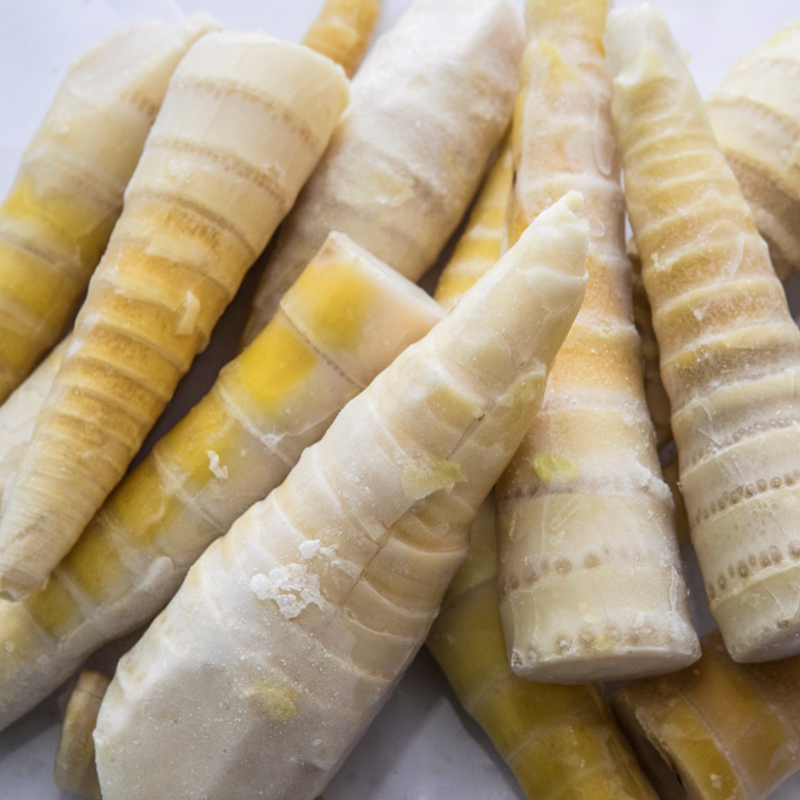
The final product maintains the original shape, pale yellow color, and crisp texture of whole bamboo shoots, providing year-round availability of this seasonal vegetable. The IQF technology extends shelf life to 18-24 months without chemical preservatives, making it an effective preservation method for this highly perishable commodity.
2. How to Choose High-Quality IQF Bamboo Shoots Whole?
Selecting high-quality IQF bamboo shoots whole requires evaluation of several objective parameters. Visual inspection serves as the primary assessment criterion. Premium quality products exhibit uniform pale yellow to cream coloration throughout all shoots in the package. The absence of discoloration, particularly dark brown or black spots, indicates proper processing and storage conditions. The shoots should maintain their natural conical shape without visible deformation or crushing.
Packaging integrity represents another crucial quality indicator. The packaging must be completely sealed without tears, punctures or frost accumulation on interior surfaces. High-quality IQF bamboo shoots should move freely within the package without clumping. Significant ice crystal formation or large ice masses suggest possible temperature abuse during storage or transportation. Legible labeling should display production date, expiration date, and batch information.
Texture assessment provides important quality information. While evaluating frozen state characteristics, shoots should maintain firmness and show no signs of freezer burn (characterized by white, dry-looking patches). The aroma should be fresh and clean without off-odors when the package is first opened. Reputable processors implement rigorous quality control measures throughout their processing lines, ensuring consistent product quality that meets international food safety standards.
Certification markings and compliance information offer additional quality assurance. Relevant food safety certifications and processing standards on packaging provide verification of quality management systems. The ingredient list should specify only "bamboo shoots" without unnecessary additives or preservatives.
3. Are IQF Bamboo Shoots Whole as Nutritious as Fresh Ones?
Nutritional comparison between IQF bamboo shoots whole and fresh varieties involves understanding the impact of processing on nutrient retention. Scientific evidence indicates that properly processed IQF bamboo shoots can maintain nutritional profiles comparable to fresh varieties, with variations depending on specific nutrients.
The rapid freezing process employed in IQF technology effectively preserves most macronutrients and micronutrients. Protein content remains largely unaffected by freezing, with studies showing retention rates exceeding 95%. Dietary fiber, particularly the insoluble fiber that constitutes a significant nutritional component, remains completely preserved through IQF processing. The low-temperature processing helps maintain structural integrity of fibrous components.
Mineral conservation represents one of IQF technology's strengths. Essential minerals including potassium (averaging 400-500 mg/100g in fresh shoots), phosphorus (approximately 50-60 mg/100g), and magnesium remain stable during freezing and storage. The blanching process prior to freezing may cause minimal leaching of water-soluble minerals, though advanced processing techniques minimize this effect through controlled parameters and rapid cooling.
Vitamin retention varies by compound type. Fat-soluble vitamins and most B-complex vitamins remain well-preserved through IQF processing. Water-soluble vitamins, particularly vitamin C and thiamine, may experience some degradation during blanching and freezing. Modern IQF processors optimize blanching time and temperature to maximize nutrient retention while ensuring food safety. Research indicates that vitamin C retention in properly processed IQF vegetables can reach 80-90% of fresh values.
Phytochemical preservation represents another advantage. Bamboo shoots contain various bioactive compounds including phenolic acids and phytosterols, which remain stable during freezing. The rapid inactivation of enzymes through blanching prevents degradation of these beneficial compounds during storage.
4. What is the Best Way to Store IQF Bamboo Shoots Whole?
Optimal storage of IQF bamboo shoots whole requires maintaining consistent low-temperature conditions and preventing quality deterioration through proper handling practices. The fundamental storage requirement involves maintaining temperatures at -18°C or lower throughout the storage period. Temperature fluctuations represent the primary factor affecting frozen food quality, causing ice crystal growth and recrystallization that damage cellular structure.
Packaging integrity plays a crucial role in long-term storage success. Original packaging designed for frozen storage typically provides adequate protection against air penetration and moisture loss. If repackaging becomes necessary, use heavy-duty freezer bags or vacuum-sealed containers specifically designed for frozen storage. Remove as much air as possible before sealing to minimize oxidation and freezer burn development.
Storage organization significantly affects product quality. Place IQF bamboo shoots whole in the coldest part of the freezer, typically away from the door and against back or side walls. Avoid storing near frequently opened doors where temperature fluctuations are most pronounced. Implement a first-in-first-out (FIFO) system to ensure proper rotation of stored products. Clearly label packages with storage dates to facilitate inventory management.
Commercial storage facilities employ advanced temperature monitoring systems and automated inventory management. These industrial-scale operations maintain strict temperature control within ±1°C variation, ensuring optimal preservation throughout the product's shelf life. For domestic storage, avoid overloading freezer capacity as this compromises air circulation and temperature maintenance.
The maximum recommended storage duration remains 18-24 months at constant -18°C, though quality optimality typically peaks within the first 12 months. Regular freezer maintenance, including defrosting manual-defrost units and temperature verification using independent thermometers, helps maintain optimal storage conditions.
5. How to Prevent IQF Bamboo Shoots Whole From Becoming Tough?
Preventing texture deterioration in IQF bamboo shoots whole involves understanding and addressing factors that contribute to toughness development. The cellular structure contains complex fibers that can become lignified and tough if not properly handled during processing and preparation.
The blanching process during manufacturing plays a crucial role in texture preservation. Properly executed blanching inactivates enzymes that cause lignification and texture hardening. Advanced processing facilities utilize precisely controlled blanching systems that apply exact time-temperature combinations to achieve optimal enzyme inactivation while minimizing structural damage. This professional processing establishes the foundation for maintaining desirable texture throughout storage and preparation.
Thawing methodology significantly impacts final texture. The recommended approach involves gradual refrigerator thawing (0-4°C) for 8-12 hours, allowing gradual ice crystal melting and water reabsorption into plant cells. Rapid thawing methods, particularly microwave thawing or room temperature exposure, cause excessive drip loss and cellular damage resulting in tougher texture. For immediate cooking applications, transferring directly from frozen state to cooking preparation can yield superior results as rapid heating helps maintain cellular integrity.
Cooking techniques determine final texture outcome. Quick-cooking methods such as stir-frying or steaming at high temperatures help preserve natural crispness. Extended boiling or slow cooking methods tend to break down cell structure excessively, potentially resulting in either mushy or unexpectedly tough textures. Maintaining crisp-tender texture typically requires cooking times of 5-8 minutes for thawed shoots and 10-12 minutes for frozen shoots added directly to preparations.
Preparation steps can further optimize texture. Slicing thawed shoots against the grain helps shorten tough fibers, improving mouthfeel. Marinating in acidic ingredients like vinegar or lemon juice for 15-20 minutes before cooking can help break down fibrous components. Adding a small amount of baking soda during cooking (approximately 1/4 teaspoon per pound) helps soften cell walls through alkaline action, though this should be used sparingly to avoid affecting flavor.
Water quality during preparation influences texture development. Using soft water rather than hard water prevents mineral interactions that can contribute to toughness. Thorough rinsing after thawing removes residual ice crystals and helps prepare shoots for optimal cooking performance. These techniques collectively help maintain the desirable crisp-yet-tender texture characteristic of properly prepared bamboo shoots.



 English
 中文简体
中文简体 日本語
日本語