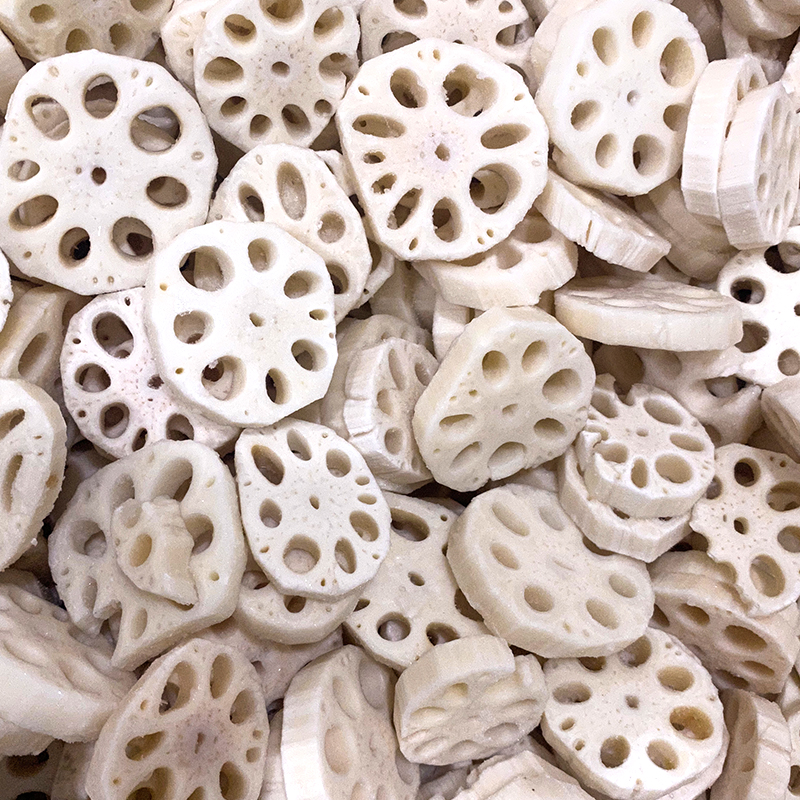
1. What are IQF Lotus Root Slices?
Individual Quick Frozen (IQF) Lotus Root Slices represent a technologically advanced preservation method for lotus root (Nelumbo nucifera), an aquatic vegetable renowned for its crisp texture and nutritional value. The IQF process involves rapidly freezing individually separated lotus root slices at extremely low temperatures (typically below -30°C to -35°C) within a short time frame, usually 10-15 minutes.
The production process begins with careful selection of fresh lotus roots, which are then cleaned, peeled, and precision-sliced to uniform thickness (typically 5-10mm). The slices undergo thorough washing to remove surface starch before entering the IQF freezing tunnel. Here, they are exposed to high-velocity cold air that quickly removes heat from each individual slice. This rapid freezing process causes water molecules within the plant cells to form numerous small ice crystals rather than large ones, which helps maintain cellular integrity and prevents tissue damage.
Companies specializing in IQF production, such as Yuyao Gumancang Food Co., Ltd., utilize fully automated processing lines that maintain strict temperature control throughout the operation. Their advanced facilities include three IQF full-automatic flow production lines with substantial processing capacity, handling up to 8,000 tons of vegetables annually. The IQF technology preserves the natural characteristics of lotus root slices while extending their shelf life to 18-24 months without requiring chemical preservatives.
The resulting IQF lotus root slices maintain their natural white color, crisp texture, and nutritional profile, offering consumers year-round access to this seasonal vegetable with minimal preparation time.
2. What are the Precautions for Storing IQF Lotus Root Slices?
Proper storage of IQF lotus root slices is crucial for maintaining quality, safety, and extended shelf life. The fundamental requirement is maintaining a consistent frozen state at -18°C or lower. Temperature fluctuations are the primary enemy of frozen products, as they cause ice crystal formation and growth, leading to cellular damage and texture deterioration.
Packaging integrity represents another critical factor. IQF lotus root slices must be stored in moisture-proof, airtight packaging that prevents air penetration and freezer burn. Industrial-scale operations like those at Yuyao Gumancang Food Co., Ltd. utilize specialized packaging materials that provide barrier protection against oxygen and moisture vapor. For home storage, if the original packaging is compromised, transfer the product to airtight freezer bags, removing as much air as possible before sealing.
Storage environment management requires attention to several aspects. Avoid placing IQF lotus root slices near the freezer door or against freezer walls where temperature fluctuations are most likely to occur. Practice proper stock rotation using the FIFO (first-in, first-out) method to ensure optimal product quality. Additionally, prevent cross-contamination by storing away from strong-smelling foods, as frozen products can absorb odors.
The storage period should not exceed the recommended 18-24 months, even under ideal conditions. Properly labeled packaging with clear production and expiration dates facilitates effective inventory management. Commercial storage facilities with daily capacity of 10,000 tons, such as those operated by Yuyao Gumancang Food Co., Ltd., implement advanced temperature monitoring systems and automated inventory management to ensure optimal storage conditions throughout the product's shelf life.
3. How to Prevent Discoloration of IQF Lotus Root Slices After Thawing?
Discoloration in thawed IQF lotus root slices primarily results from enzymatic browning, a natural biochemical process where polyphenol oxidase enzymes catalyze the oxidation of phenolic compounds to quinones, which then polymerize to form brown pigments. Preventing this discoloration requires interrupting this enzymatic process at various stages.
The initial processing stage incorporates crucial preventive measures. Professional processing facilities implement immediate post-harvest processing where lotus roots are rapidly cleaned and sliced, then treated with anti-browning agents. These may include food-grade compounds such as ascorbic acid (vitamin C), citric acid, or calcium chloride solutions that either lower pH to inhibit enzyme activity or complex with substrates to prevent oxidation.
The blanching process represents another critical control point. Exposure to hot water or steam (typically 90-95°C for 2-3 minutes) denatures the polyphenol oxidase enzymes, effectively preventing enzymatic browning. This thermal processing must be precisely controlled to achieve enzyme inactivation while maintaining the vegetable's crisp texture and nutritional value.
For consumers and food service operators, post-thawing handling techniques can minimize discoloration. Immediate cooking after thawing prevents browning by applying heat that destroys any remaining enzyme activity. Alternatively, briefly immersing thawed slices in acidulated water (water with added lemon juice or vinegar) maintains a low pH environment that inhibits enzymatic activity. Cooking methods that quickly reach high temperatures, such as stir-frying or deep-frying, are particularly effective at preserving the natural white color of the lotus root slices.
4. How is the White Appearance of IQF Lotus Root Slices Maintained?
The preservation of the characteristic white appearance in IQF lotus root slices involves a multi-faceted approach combining advanced processing technologies and scientific principles. The initial quality selection is paramount – only fresh, undamaged lotus roots with naturally white flesh are selected for processing.
The technological processing plays a crucial role in color preservation. Modern facilities like those operated by Yuyao Gumancang Food Co., Ltd. employ automated processing lines that minimize exposure to air during cutting and handling. Immediately after slicing, the lotus root undergoes treatment in antioxidant solutions, typically containing food-grade additives such as sodium acid pyrophosphate, citric acid, or ascorbic acid. These compounds work by chelating metal ions that catalyze oxidation and by reducing already-formed quinones back to colorless phenolic compounds.
The blanching process serves dual purposes in color preservation. Beyond enzyme inactivation, blanching removes surface starch and air from tissues, resulting in a more translucent, brighter white appearance. The rapid IQF freezing then locks in this appearance by forming numerous small ice crystals that minimize light scattering and maintain cellular integrity.
Packaging technology contributes significantly to color maintenance. Oxygen-impermeable packaging materials prevent oxidative reactions during storage, while proper sealing techniques eliminate air pockets that could cause localized discoloration. Some processors employ modified atmosphere packaging with nitrogen flushing to further reduce oxidative processes.
Throughout the process, water quality management is essential. Processing facilities use purified water with controlled mineral content to prevent iron and other metals from causing discoloration through complex formation with phenolic compounds.
5. How Should IQF Lotus Root Slices Be Properly Thawed?
Proper thawing of IQF lotus root slices is essential for maintaining their texture, color, and nutritional quality. The recommended method depends on the intended use, but all approaches share the common goal of minimizing quality deterioration during the phase change from frozen to thawed state.
For immediate cooking applications, the most effective method is direct cooking from frozen. This approach is particularly suitable for methods such as stir-frying, deep-frying, or adding to soups and stews. The direct application of heat quickly passes through the critical temperature zone where quality deterioration is most likely to occur, while the rapid heating inactivates enzymes that cause discoloration. This method also minimizes drip loss, preserving the natural texture and nutritional content.
When thawing before cooking is necessary, the recommended method is refrigeration thawing. Transfer the required amount of IQF lotus root slices from the freezer to a refrigerator (0-4°C) for 6-8 hours or overnight. Place the slices in a colander or strainer over a bowl to catch any melt water, and cover with plastic wrap to prevent dehydration and odor absorption. This slow, low-temperature thawing allows for gradual ice crystal melting and water reabsorption into the cells, better preserving the cellular structure and texture.
For situations requiring faster thawing, the cold water method can be employed. Keep the IQF lotus root slices in their original sealed packaging or place in a leak-proof plastic bag. Submerge in cold water (below 21°C), changing the water every 30 minutes to maintain low temperature. This method typically takes 1-2 hours, depending on the quantity.
Regardless of the method chosen, certain practices should be avoided. Never thaw at room temperature for extended periods, as this promotes microbial growth and enzymatic activity. Do not refreeze thawed lotus root slices, as this causes further cellular damage and quality deterioration. After thawing, the slices should be cooked promptly to maximize quality and safety.
Advanced processing facilities implement rapid freezing technologies that create smaller ice crystals, resulting in products that withstand the thawing process better with minimal quality loss. The sophisticated freezing equipment employed by companies like Yuyao Gumancang Food Co., Ltd., with their substantial daily storage capacity, ensures that the IQF lotus root slices maintain optimal characteristics throughout the cold chain until preparation.



 English
 中文简体
中文简体 日本語
日本語