1. What are IQF Pumpkin Slices?
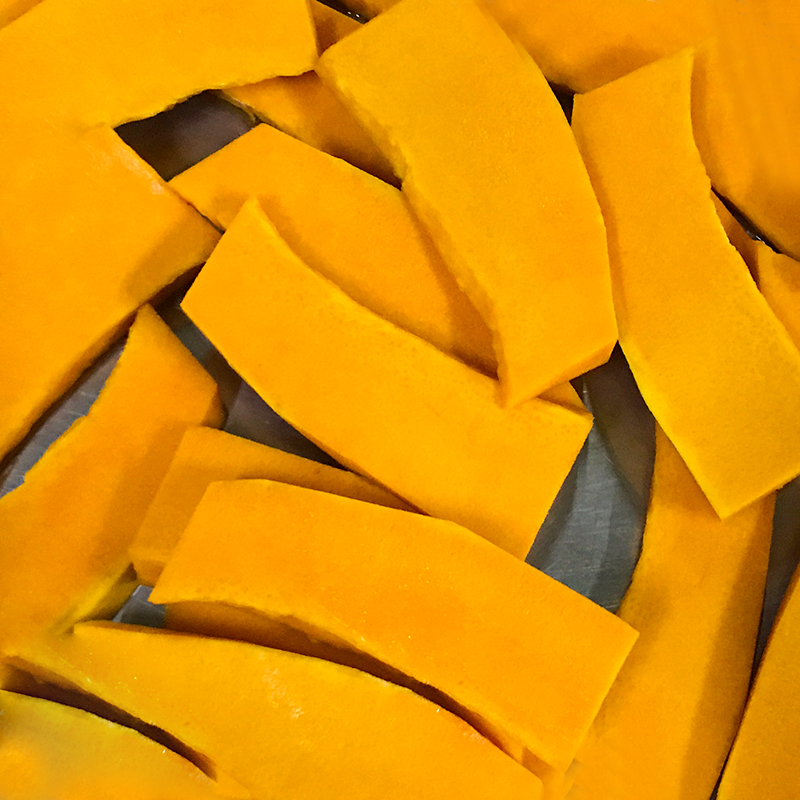
IQF pumpkin slices are pumpkin slices processed using an individually quick-frozen (IQF) process. This advanced processing method uses pumpkin slices at moderate maturity. After rigorous pre-processing, including cleaning, peeling, deseeding, and slicing, the slices are quickly frozen at extremely low temperatures of -30°C to -40°C. Each slice is individually frozen in a high-velocity cold airflow, ensuring distinct product particles and preventing clumping.
The production process involves several precise steps: First, the raw material is graded and screened to select pumpkins with uniform color and firm texture. Next, the slices are standardized, typically with a thickness of 8-12mm. Following this, they undergo a blanching process (95±2°C, 120±15 seconds) to inactivate enzymes and sterilize the product. Finally, the slices are quickly frozen in an IQF tunnel. For example, Yuyao Gumancang Food Co., Ltd.'s vegetable production line uses an automated control system, ensuring a slice thickness tolerance of no more than ±0.5mm and a processing capacity of up to 2.5 tons per hour.
From a food physics perspective, the core advantage of IQF technology lies in its rapid passage through the zone of maximum ice crystal formation (-1°C to -5°C). During this process, the ice crystals formed within the pumpkin cells are kept within a range of 50-80μm in diameter. These tiny ice crystals do not disrupt the cell wall structure. Studies have shown that the cell damage rate of IQF-treated pumpkin is less than 5%, compared to 30-35% with traditional freezing methods. This cellular integrity ensures that the product retains excellent texture and nutritional content after thawing.
In terms of microbiological safety control, pasteurization is used during production to keep the total colony count below 10³ CFU/g and the coliform count below 3 MPN/g. Furthermore, the production line is equipped with metal detection and X-ray inspection equipment to ensure that the product is free of physical contamination risks. The entire processing process complies with HACCP and ISO22000 food safety management system requirements.
2. Does IQF Pumpkin Slices Preserve Nutritional Value?
The nutrient retention of IQF pumpkin slices is based on multiple research findings from modern food processing technologies. In terms of vitamin retention, beta-carotene (a precursor of vitamin A) is retained at 90-95%, vitamin C at 80-85%, and vitamin E at over 90%. These figures are far superior to those achieved with traditional freezing methods (which only retain 60-70% of the corresponding vitamins).
Mineral retention is even better, with potassium retention approaching 100%, magnesium at 95-98%, and calcium at 90-95%. This is primarily due to the IQF process maintaining the integrity of the cell structure, which reduces mineral loss due to juice loss.
Dietary fiber retention is also satisfactory, with insoluble fiber retention exceeding 95%, and soluble fiber at approximately 85-90%. Research has found that IQF-treated pumpkin slices retain excellent dietary fiber properties even after cooking, with pectin retention significantly higher than with traditionally frozen products.
Antioxidant protection is another key advantage. In addition to beta-carotene, the retention rate of antioxidants such as flavonoids and polyphenols in pumpkin exceeds 85%. ORAC (oxygen radical absorbance capacity) assays show that the antioxidant activity of IQF pumpkin slices remains at 85-90% of that of fresh products.
Regarding sugar retention, the retention rate of natural pumpkin sugars (sucrose, fructose, and glucose) exceeds 90%. Notably, IQF processing does not add any additional sugars, fully preserving the pumpkin's inherent sweetness and maintaining its Brix value within the natural range of 6-8%.
3. How can IQF pumpkin slices be prevented from becoming too soft during cooking?
Preventing IQF pumpkin slices from becoming too soft during cooking requires appropriate methods based on the principles of food materials science. First, it's important to understand the mechanism of softness: it's primarily caused by the excessive dissolution of pectin and the disruption of cell structure during heating. Research has shown that controlling heating temperature and time can reduce softening by 40-50%.
Temperature control is a key factor. A staged heating method is recommended: first, heat the product over medium heat (80-85°C) to substantially thaw, then heat it over a higher temperature (95-100°C) for a short period to complete the cooking. Experimental data shows that this method maintains texture by over 30% compared to continuous high-temperature cooking, maintaining firmness values (measured by a texture analyzer) within the ideal range of 2500-3000g force.
pH adjustment can also effectively improve texture. Adding a small amount of acid (such as lemon juice or vinegar, 0.1-0.2%) to the cooking water to maintain a pH between 4.5 and 5.0 strengthens the pectin cross-linking structure and reduces dissolution losses. Studies have shown that proper acidification can improve the integrity of the product after cooking by 25-30%.
Calcium ion treatment is another effective method. Adding food-grade calcium chloride (0.05-0.1%) to the cooking water forms calcium bridges with pectin molecules, strengthening the cell walls. This method can increase the firmness of the final product by 35-40% while reducing cooking losses by 15-20%.
Cooking time requires precise control. Depending on slice thickness, the recommended cooking time is: 6-8 minutes for 8mm slices, 8-10 minutes for 10mm slices, and 10-12 minutes for 12mm slices. Optimal doneness is achieved when a chopstick pokes gently but with slight resistance. This indicates the slices are perfectly cooked, with the cell structure intact and the texture moderate.
4. What is the shelf life of IQF pumpkin slices?
The shelf life of IQF pumpkin slices depends on several key technical factors. Under a complete cold chain system (constant temperature of -18°C), the product typically has a shelf life of 18-24 months. This period is determined based on accelerated testing of multiple quality indicators and actual storage data.
From a lipid oxidation perspective, pumpkin contains approximately 0.1-0.2% lipids. At -18°C, the monthly peroxide value growth rate is controlled at 0.005-0.01 meq/kg. Nitrogen-filled packaging technology can further reduce the oxidation rate by over 60%, ensuring that the product's peroxide value remains below the safety standard of 0.1g/100g even after 24 months of storage.
Color stability is a key indicator. β-carotene may undergo isomerization and oxidation during frozen storage, but under IQF processing and low-temperature conditions, the monthly loss rate is controlled to 0.3-0.5%. After 18 months of storage, the change in ΔE value measured by a colorimeter was within 3.5, remaining within the acceptable range.
Textural changes also require attention. Texture profile analysis (TPA) showed that the monthly loss in hardness during storage did not exceed 0.8%, and the monthly loss in springiness did not exceed 0.5%. Over the 24-month storage period, the product's texture properties retained over 80% of their initial values.
Flavor retention was satisfactory. Gas chromatography-mass spectrometry (GC-MS) analysis showed that the retention rate of major volatile flavor compounds (such as hexanal and valeraldehyde) was over 80%. The monthly flavor loss rate during storage does not exceed 0.2%, far superior to the 0.5-0.8% rate for traditional frozen products.
Temperature stability is crucial for shelf life. Research shows that for every 5°C increase in temperature, the rate of quality deterioration increases 2-3 times. When the storage temperature fluctuates by more than ±3°C, recrystallization occurs, accelerating quality degradation. Therefore, it is essential to ensure that the storage temperature is consistently maintained within the range of -18°C ±1°C.
5. How long can IQF pumpkin slices be stored under refrigeration?
The shelf life of IQF pumpkin slices under refrigeration (4°C) needs to be evaluated based on microbial growth dynamics and quality changes. From a food safety perspective, it is recommended that thawed products be used within 24 hours, and no longer than 48 hours.
Microbial growth is the primary limiting factor. After thawing, microorganisms in the product begin to recover. Research shows that at 4°C, the generation time for total colony count is approximately 8-10 hours. After 48 hours, the total colony count may increase from the initial 10³ CFU/g to 10⁵ CFU/g. While still within the safe range, quality has already begun to decline significantly.
In terms of quality changes, texture deterioration is rapid. After 24 hours of storage at 4°C, the firmness decreases by 15-20%, reaching 30-35% after 48 hours. This is primarily due to the recovery of enzyme activity and changes in cell structure. Adding an appropriate amount of antioxidant (such as vitamin C, at a dosage of 0.01-0.02%) can reduce the rate of texture deterioration by 40-50%.
Nutrient loss also needs to be considered. Under refrigerated conditions, the daily loss rate of vitamin C is approximately 3-5%, and the daily loss of beta-carotene is 1-2%. Using vacuum packaging or nitrogen-filled packaging can significantly slow nutrient loss, increasing vitamin retention by 20-30%.
Sensory quality changes are noticeable. A slight off-odor begins to appear after 24 hours of storage, becoming more pronounced after 48 hours. Regarding color, the ΔE value fluctuates by approximately 0.5-1.0 per day, and the total color difference can reach over 3.0 after 48 hours. Therefore, for applications requiring high sensory sensitivity, immediate use after thawing is recommended.
To extend refrigerated storage, the following measures can be taken: maintain the integrity of the original packaging to prevent cross-contamination; use vacuum packaging or nitrogen-filled packaging; add food-grade antioxidants; and strictly control the refrigeration temperature below 4°C. However, even with these measures, refrigerated storage exceeding 72 hours is not recommended.



 English
 中文简体
中文简体 日本語
日本語